|
Implementation
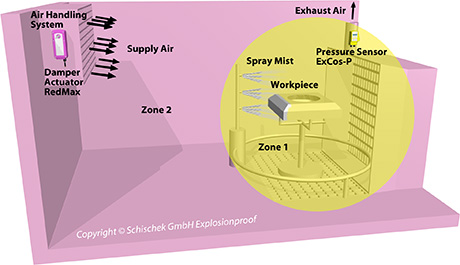
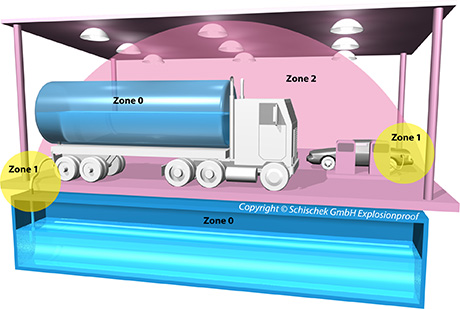
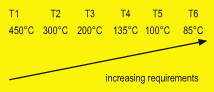
Areas with potentially explosive atmospheres are divided into zones, equipment has to be divided into groups and categories. The labelling on the identification plate of certified equipment indicates in which zone the explosion protected equipment can be used.
Division into product groups
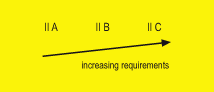
Equipment is divided into group I and group II. Group I consists of underground mines and group II deals with all other applications.
Division into zones
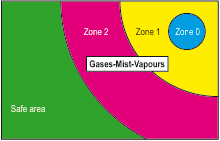
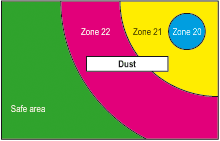
Areas with potentially explosive atmospheres are divided into six zones according to the probability of how frequent and for which period of time a potentially explosive atmosphere (p.e.a.) exists.
A distinction is made between combustible gases, mists, vapors and combustible dust.
For gases, mists and vapors zones 0, 1 and 2 exist, in which the requirements for the chosen equipment increase from zone 2 to 0. Equipment in zone 0 must be built in a way "that even if a type of protection fails or if two faults occur, that sufficient explosion protection is guaranteed". Therefore for example a passive, potential free sensor, installed in zone 0, and connected to an intrinsically safe electric circuit (II 2 (1) G [Ex ia] IIC), needs its own approval.
Zones 20, 21 and 22 are for dust atmospheres, in which the requirements for the chosen equipment increase from zone 22 to 20. Equipment in zone 20 and 21 need special approval.
|